









Content
- When are interdental brushes and floss a better choice?
- Why is brushing your teeth not enough for the interdental spaces?
- How to choose the brush size?
- How are interdental brushes used correctly?
- What to use around implants, bridges and braces?
- What if my gums bleed or cleaning hurts?
- Dr Mladen Popović and MonDent: choosing care according to your teeth
- Frequently asked questions
- Choose a tool that can help you properly clean every space.
Use interdental brushes where they can pass without force and the bristles touch the sides of the teeth. For tight spaces where a toothbrush cannot pass, dental floss is more suitable. Many people need both, in different places. The choice depends on the spacing between teeth, the condition of the gums, and the presence of bridges, implants, or braces.
So you don't have to decide that you'll only use one from now on. It's more important to know what you can use to clean every area, without hurting your gums or skipping hard-to-reach spots.
Maybe you brush your teeth regularly, but food keeps getting stuck between the same two teeth. Or you bought an interdental brush, tried to insert it, and gave up because it got stuck. Such situations require checking the size, technique, and the space itself.
At MonDent, we also care about how you maintain your teeth at home. The care recommendation should suit your mouth and the movements that you can repeat correctly every day.
When are interdental brushes and floss a better choice?
The simplest rule is: the brush should fill the space with fibers and pass through without applying too much pressure. If this is not possible, do not try to push it in.
Brushes for areas that I can properly access
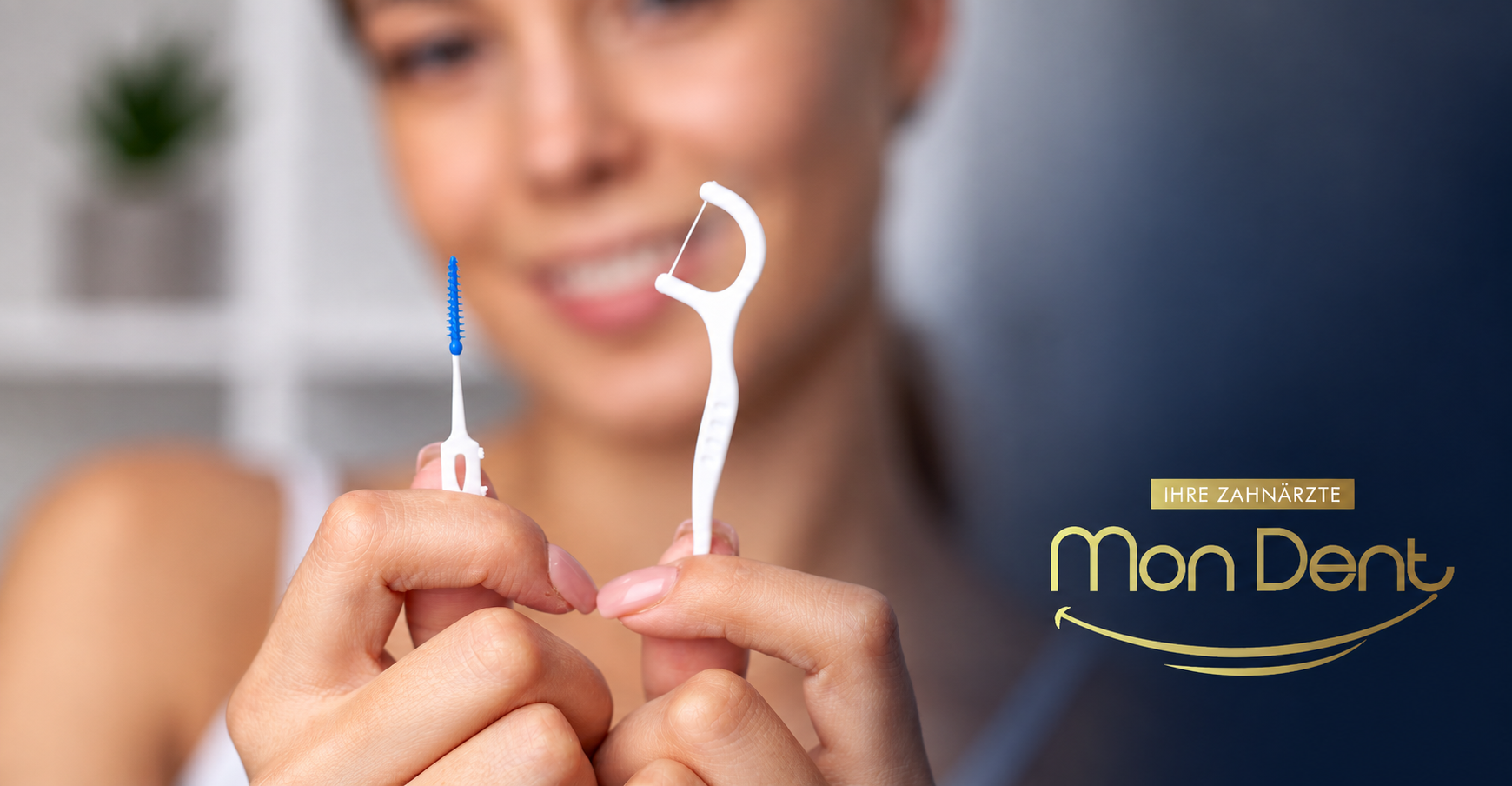
Interdental brushes are useful between teeth where there is enough space for the appropriate size. Their bristles come into contact with the side surfaces and remove plaque.
They can be particularly practical for wider interdental spaces, receding gums and certain prosthetic work. However, the placement of a bridge or implant requires individual demonstration of the technique.
Just because a brush goes through easily doesn't automatically mean it cleans well. If it's too small and barely touches the surrounding surfaces, you need to check the size.
Floss for narrow teeth
Flossing is often more appropriate where teeth are closely spaced. It is inserted carefully, without pressing hard into the gums, and then placed against the side surface of each adjacent tooth.
Simply sweeping through the middle of the space is not enough. The goal is to clean the surfaces where deposits are held.
If you have difficulty flossing, ask your dentist to show you the technique. You may prefer a device with a holder, but even that needs to be used correctly.
You can use both tools
For example, you may find it helpful to floss between some of your front teeth and a toothbrush between your back teeth. The arrangement is not the same for every patient.
It is most useful to leave the examination with a clear answer: which aid you use, in which place and with which movement.
Why is brushing your teeth not enough for the interdental spaces?
Use a regular toothbrush to clean the accessible outer, inner and chewing surfaces. However, its bristles do not reach all the lateral surfaces between the teeth equally well. Plaque, a sticky layer containing bacteria, can remain there.
Food debris and plaque are not the same. Even if you can't see anything between your teeth, those areas need to be cleaned. A toothpick that removes a stuck piece of food doesn't do the same job as a proper plaque removal tool.
Interdental brushes and floss therefore complement regular brushing. They do not replace a regular toothbrush or professional cleaning when necessary.
If the deposits have already hardened into limescale, home cleaning will not remove them. Read more about this in the text. How tartar forms on teeth.
How to choose the brush size?
You can see several colors and sizes on the packaging, but the right choice starts with the area you're cleaning. The brush should fit that area, without causing pain, snagging, or bending the wire due to pressure.
Why isn't the smallest always the right choice?
The smallest brush may be the most gentle, but in a wide space it may not touch the side surfaces enough. Too large, on the other hand, requires pushing and can hurt the gums.
The appropriate size passes through with slight resistance from the fibers. The wire should not scrape the tooth or deform with each insertion.
Don't choose based on the color of the handle alone. Manufacturer markings can vary, so check the dimensions when changing brands. Keep the packaging of the model that suits you.
One size does not fit all teeth
The spaces between the front and back teeth are often not the same. So you may need two or more sizes, especially if you have receding gums or dentures.
Ask your dentist to show you the schedule. A quick note in your phone can help until you remember where each toothbrush goes.
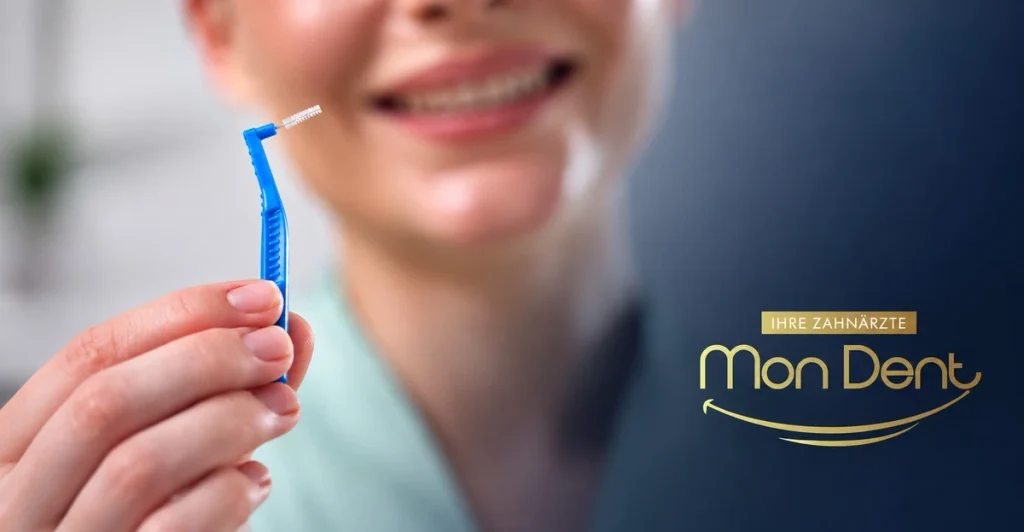
Pay attention to the handle as well. For the back teeth, some people prefer a longer or angled handle, as it makes access easier without unnatural twisting of the hand.
How are interdental brushes used correctly?
Start in front of a mirror and give yourself plenty of time. The first few attempts are to get used to the direction of entry and the size arrangement. You don't have to work fast right away.
Gentle movement, no forcing
The basic procedure looks like this:
- Wash your hands and get the right size.
- Point the tip towards the space between the teeth, along the gum line.
- Insert the brush gently, without piercing the gums or applying strong pressure.
- Make a controlled in and out motion, according to the manufacturer's instructions.
- Rinse the brush and move on to the next area.
Do not scrub one area for too long or too hard. The number of strokes depends on the product's construction, so follow its instructions and the dentist's demonstration.
If the brush does not pass, stop. The reason may be the size or the angle of entry. Sometimes the space is too narrow and you need to use floss.
Enter a sequence that you can remember.
You should usually clean the interdental spaces once a day, along with your regular teeth brushing. Choose a time when you are not in a rush.
Always move in the same order, from the last teeth on one side to the other. This will make it easier to notice any missed spots.
If you miss a day of care, continue as usual the next day. You cannot make up for missed cleaning by applying more pressure.
Maintain your toothbrush too
After use, rinse it with water and leave it to dry in a clean place. Do not share it with other people. Check that the fibers are intact and the wire is not damaged.
If it deforms quickly, check the technique and size. Constantly replacing it with the same model will not solve the problem of improper insertion.
Keep interdental brushes with your other dental care products. If you use multiple sizes, arrange them so that they are easy to distinguish. Take a spare when traveling and keep the label of the product that suits you.
What to use around implants, bridges and braces?
Prosthetic work and appliances change the approach to certain surfaces. Therefore, the cleaning method depends on your specific work, along with the selection of appropriate tools.
Around implants and under the bridge
Interdental brushes can help clean the spaces around implant restorations and under accessible bridgework. The size, shape, and direction of entry should match the design of the restoration.
For implants, use products intended for such use, usually with a protected wire. Immediately after surgery, follow your surgeon's instructions on when and how to begin cleaning the surgical area.
With a bridge, the area under the part that replaces the missing tooth should also be cleaned. Sometimes a special floss is more suitable, and sometimes a combination of devices is more suitable. Do not try to separate the connected parts with a brush.
Correct care after bridges, crowns and implants It is important for the preservation of the surrounding teeth and tissues, as well as for the longevity of the work itself. Therefore, before leaving the office, check that you know how to access all surfaces that need to be cleaned.
Read more about maintenance and inspections in our article about dental bridges.
Around the braces and braces wire
With fixed braces, extra care is needed around the brackets and under the wires. For these areas, your orthodontist may recommend a different size toothbrush than the one you use to clean between your teeth.
Do not pull the wire or use the lock as a support for pushing. If you have difficulty accessing a particular area, point it out to the inspector. You can find more tips in our guide to wearing braces.
What if my gums bleed or cleaning hurts?
Slight bleeding at the beginning of cleaning may be related to gum inflammation. It is also possible that the size is not suitable for the space or that the movements are too rough. Blood is not a sign that you have cleaned the area properly.
Check your technique and do not force the painful area. If bleeding recurs, does not decrease, or is accompanied by swelling and pain, schedule an appointment. Heavy or spontaneous bleeding requires earlier evaluation.
In gum disease, home care is part of the treatment and maintenance of results. Overview within periodontology and oral medicine It allows for the assessment of the cause of the problems and the selection of therapy.
Tell your dentist if only one spot is bleeding, if there is pain during insertion, and what size you are using. These details help to tailor the recommendation more precisely.
Dr Mladen Popović and MonDent: choosing care according to your teeth
Dr Mladen Popović He has been improving his skills through training in tooth preparation for fixed prosthetic restorations and modern treatment of gingival recessions, or receding gums. Prosthetic work and altered gum position are situations in which daily care needs to be carefully adjusted.
Therefore, choose interdental brushes after assessing the area and surrounding tissue. During your check-up, ask for a demonstration of the area that is causing you problems.
At MonDent, we care about every patient and their habits. Let us know if your appliance keeps getting stuck, you have difficulty reaching your back teeth, or you skip cleaning under your bridge. It is important to us that you can apply the recommendation at home.
What to bring to the examination?
Bring the toothbrushes or floss you currently use, along with the packaging if you have it. Show the area you are skipping and explain why.
It is more useful to practice the correct movement than to buy several new products without a clear idea of how to use them.
Conclusion
Interdental brushes and floss have their place in daily care. The best choice is one that can access specific surfaces, remove plaque, and protect your gums from injury.
If you get stuck in the same spot or are unsure of the size, Schedule an appointment at MonDentBring the aids you use so we can check your routine and show you what needs to be adjusted.
Frequently asked questions
Should I use both toothbrushes and floss every day?
Interdental spaces should be cleaned daily, but you don't have to use both tools in every area. Flossing can be used for tight spaces, and a toothbrush for wider spaces. Adjust the schedule with the help of your dentist.
How often should interdental brushes be changed?
Replace them when the fibers wear out, the wire becomes deformed or its protection is damaged. Follow the manufacturer's instructions. The duration depends on the product, the number of spaces you clean and the way you use it.
Can toothbrushes create gaps between teeth?
A properly selected toothbrush, inserted without force, is not intended to move teeth. A brush that is too large and rough movements can injure the gums. If you notice a change in space or receding gums, seek an examination.
Can oral irrigator replace floss and toothbrushes?
An oral irrigator can be a useful additional tool, especially with certain prosthetic works. Do not assume that it replaces all other means. Your dentist can assess which combination is suitable for your teeth and maintenance method.


 BA
BA DE
DE SL
SL EN
EN ZH
ZH it_IT
it_IT