










Content:
- What are composite veneers?
- When are composite veneers ideal?
- The process of placing composite veneers
- Advantages and disadvantages of composite veneers
Composite veneers are a quick and effective way to improve the color and shape of your teeth, especially when it comes to minor cosmetic defects that cannot be addressed with regular whitening. Unlike whitening, which only affects the shade of your teeth, composite veneers correct the shape, color, and size of your teeth in one procedure. At the same time, they are less invasive than crowns – veneers are placed on the surface of your teeth without the need for significant grinding. The first sentence gives the key answer: when you want a quick aesthetic correction of minor defects, veneers are often a better choice than whitening or massive prosthetic crowns.
In short, teeth whitening can remove dark stains and brighten a tooth, but it cannot change the shape or repair cracks. If a patient just wants a whiter smile and all the teeth are in perfect shape, whitening is enough.
Your dentist will decide whether you need teeth whitening or composite veneers during your examination. Schedule an appointment at our dental office and consult with our team of experts.
What are composite veneers?
Composite veneers are thin shells made of composite resin that are applied directly to the front of the tooth by the dentist. The goal is to improve the appearance of the tooth – its color, shape, and size – without significant tooth preparation. The veneer material is dyed to match the patient’s natural tooth color, so the teeth look very natural and uniform.
Unlike ceramic veneers, which are made in a laboratory and often require grinding of the tooth, composite veneers can be placed in a single visit with no (or minimal) grinding of the tooth. This makes the procedure quick and painless. Most veneers are made and placed in a single appointment, often without the need for anesthesia.
After the dentist prepares the tooth surface, he or she applies layers of composite and shapes them with appropriate instruments. Finally, the material is cured with an ultraviolet (UV) lamp, and the veneer is polished to a shine. Overall, the entire procedure can take just 30–60 minutes per tooth.

Composite veneers vs teeth whitening
The main difference between composite veneers and whitening is the scope of the correction. Teeth whitening (professional whitening) specifically lightens the shade of an existing tooth. This is a great solution if your teeth are uniformly healthy and you just want a whiter smile. However, the light shade does not solve other problems – such as surface damage or uneven spacing between teeth. Composite veneers, on the other hand, change the color and shape at the same time. They can be used on teeth that are discolored or have minor surface damage (such as scratches or small cracks). They also close small gaps and shape irregular teeth to look straighter and more harmonious.
In other words, veneers can correct what whitening cannot: small irregularities, irregular shape and asymmetry. Additionally, whitening usually requires multiple visits (depending on the method), while composite veneers are done right at the dentist. So if a patient is happy with the size and shape of their teeth, but wants a whiter smile, we choose whitening. But if they want to change both the shape and color, or even close the gap, composite veneers are often a better choice.
Composite veneers vs crowns
Crown is a prosthetic restoration that is placed on a tooth after the tooth has been previously ground down to the size of the crown. This allows the crown to change almost everything – the shape, color, size and position of the tooth, making it suitable for major corrections and very damaged teeth. However, grinding means removing a significant amount of tooth structure, which is an invasive procedure. Crowns are great if the tooth has already been treated, broken or filled – they then protect the remaining tooth and extend its lifespan.
Composite veneers, on the other hand, are glued to the front side of a relatively healthy tooth. They are not intended for drastic repairs, but for the aesthetic correction of minor defects. The placement of veneers usually does not require grinding or only a thin grinding of the front surface is performed (if necessary). Therefore, veneers do not protect a weakened tooth like a crown, but they preserve a larger part of the natural tooth and allow treatment without anesthesia.
So, for major tooth problems (e.g., a significant fracture, severely cracked tooth, or a tooth root that needs protection), we will most likely recommend a crown. For minor cosmetic repairs—slight dentinal changes, discoloration, and minor alignment—composite veneers are ideal.
When are composite veneers ideal?
Composite veneers are suitable for patients seeking quick correction of close-up aesthetic problems. The most common cases are:
- Minor damage: If some of your front teeth are slightly chipped or cracked, a veneer can replace the lost part and restore a natural shape.
- Discoloration: Teeth that have changed color (e.g. due to antibiotics or trauma) can be covered with a veneer one shade lighter, which is not possible with pure whitening.
- Gaps (diastemas): Smaller gaps between teeth can be easily closed by bonding veneers to the outsides of adjacent teeth, creating a uniform smile.
- Irregular tooth shape: Slightly irregular or differently shaped teeth (e.g. one tooth longer, another shorter) can be aligned with veneers to make the teeth appear symmetrical.
- Minor settlements: In cases where orthodontic therapy is not required, veneers can correct the tilt or rotation of the front teeth to a much lesser extent.
Veneers are recommended when the teeth are healthy, without active caries or severe inflammation, but the patient wants a better appearance. If, for example, there is gum disease, it should be treated first. Also, if the teeth are very badly damaged or if the patient has severe bruxism (teeth grinding), the dentist may suggest a different treatment before veneers. But for all other cases mentioned – where “less is more” – composite veneers are often a quick, safe and aesthetically pleasing solution.
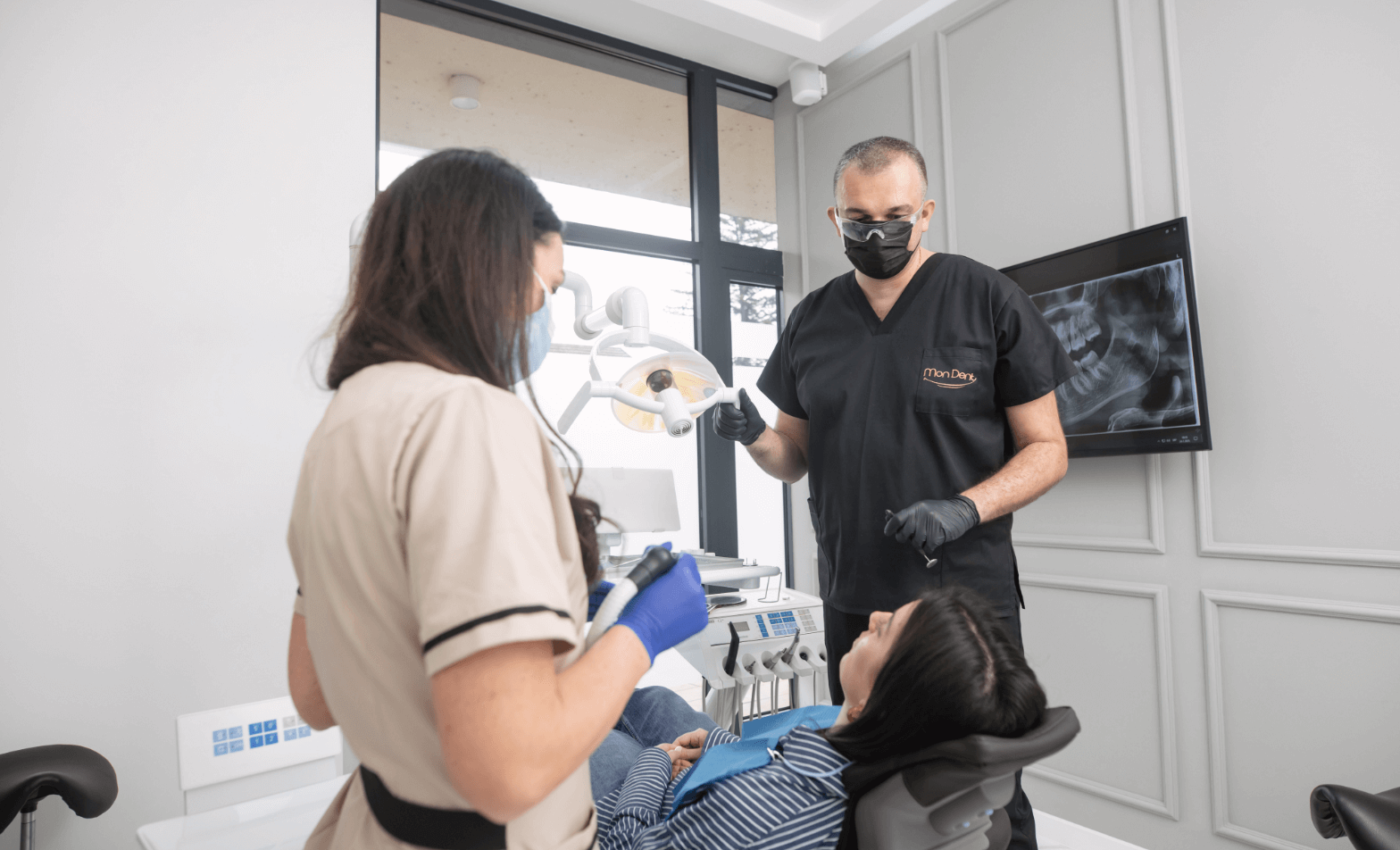
Composite veneers are applied in layers directly to the front of the tooth. In the image, the dentist carefully forms the veneer on the patient's tooth, while UV light hardens the material. This achieves the desired color and shape of the tooth in situ.
The process of placing composite veneers
- Overview and planning: First, you will come for a dental examination. The dentist checks the health of your teeth and gums and decides if veneers are a possible option. Then, the shade of the composite material is selected using a shade guide so that the color of the veneer blends naturally with the rest of your teeth.
- Tooth preparation: The tooth is gently prepared by roughening the surface (sandblasting) to make it easier for the material to adhere, and a special liquid (primer) is applied for better adhesion. If necessary, a very thin layer of enamel is removed, but significant grinding is usually not necessary.
- Applying composite: After preparation, layers of composite in the desired shade are applied to the front surface of the tooth. The dentist shapes the material to the optimal shape of the tooth – achieving a perfectly regular contour and size as agreed with the patient. After each modeling phase, the composite is briefly hardened (hardened) with an ultraviolet lamp to maintain its shape.
- Final processing: Once the desired look is achieved, the veneer is polished to a smooth and shiny finish, matching the rest of the teeth. This gives the tooth a completely natural look and a final, radiant shine. This step only takes a few minutes, and the patient can see the results immediately.
- After the procedure: Veneers are ready to wear immediately, with no recovery period – you can eat, drink and speak normally. The entire procedure per tooth usually takes no longer than an hour.

Advantages and disadvantages of composite veneers
Advantages
Composite veneers are minimally invasive – unlike crowns, they don’t require extensive grinding. They are placed quickly, often in a single visit to the dentist, meaning less waiting and faster results. The procedure is less expensive than ceramic veneers, yet provides a significant improvement in the shape and color of the tooth. If a veneer becomes damaged or discolored over time, it can be easily repaired or replaced, which is not as easy with ceramic veneers. Patients often report that veneers give them a natural, beautiful smile with minimal intervention.
Me
The main disadvantage is. Composite resin is not as strong as ceramic or natural tooth, so veneers can crack or wear out over time. They usually last less than ceramic veneers (a few years). Composite is also more easily stained by exposure to red wine, coffee, tea, and tobacco, so it is important to keep veneers from frequent staining. In addition, regular maintenance – thorough brushing, flossing, and preventive checkups – is necessary to extend the life of your veneers. In rare cases, patients with severe bruxism can damage their veneers and may not be the best candidates for composite veneers.
In practice, the balance of advantages and disadvantages depends on the case: for patients looking for a quick and inexpensive improvement in appearance, veneers are often a great solution; for those who want maximum durability and precision, ceramic veneers or other options may be considered.
Conclusion
Composite veneers are the ideal choice when you want a quick and non-invasive aesthetic improvement to your smile. They allow you to repair slightly damaged or irregular teeth in just one visit, without the need for complex grinding as with crowns. Unlike regular whitening, veneers change both the color and shape of the teeth, making them useful for minor corrections. MonDent Dental Clinic has a team of experts and modern equipment for the precise manufacture and installation of veneers.
If you are thinking about creating a dazzling smile and have minor tooth damage, our staff can assess whether you are a candidate for composite veneers and offer a personalized solution. In any case, composite veneers provide an elegant and affordable solution to many aesthetic problems, allowing you to shine without complex procedures.
Frequently Asked Questions (FAQ)
What is the difference between composite and ceramic veneers?
Composite veneers are applied directly by the dentist and are made of resin, while ceramic veneers are made in a dental laboratory and are more durable. Ceramic veneers usually require precise grinding of the teeth, while composite veneers are minimally invasive.
Is the procedure for placing composite veneers painful?
No, there is usually no need for anesthesia, as the procedure is performed on the surface of the tooth and is quick. In our office, the procedure is pleasant and quick, and most patients do not feel any discomfort.
How long do composite veneers last?
With proper care, veneers usually last for several years (usually 5–7 years). After that, they are easy to renew or replace. It is important to pay attention to oral hygiene and avoid bad habits in order to extend the life of veneers.
Can veneers be removed?
Yes, composite veneers can be removed from a tooth with minimal consequences. After removal, the tooth will remain largely intact (for the same reason that the procedure was minimally invasive). The tooth can then be given other treatment if necessary (e.g. a crown).
When are crowns a better solution than veneers?
Crowns are better when teeth are severely damaged, cracked, or have been treated (cabinets provide strength for broken teeth). Composite veneers are chosen when teeth are healthy and we want to correct minor aesthetic defects.


 BA
BA DE
DE SL
SL EN
EN ZH
ZH it_IT
it_IT